Buying a landed home is often framed as a graduation moment — more space, more privacy, more freedom. But in District 20, one of Singapore’s most mature and structurally stable landed districts, the question is rarely whether a landed home is desirable. The more important question is which type of landed home truly fits your life stage, financial comfort, and long-term intentions — at the right price point.
D20 is not a speculative or rapidly transforming district. Its landed enclaves in Thomson, Bishan, and Ang Mo Kio have evolved steadily over decades, shaped by owner-occupiers, families, and long-term holders. Pricing here reflects that maturity. Each landed typology plays a distinct role, serves a different demographic, and comes with its own financial thresholds that buyers need to understand clearly before committing.
This guide looks at what each type of landed home in D20 is best suited for, what typical price ranges look like today, and what buyers should take note of before deciding.
Understanding D20’s Landed Landscape
District 20 is defined by balance rather than extremes. It combines central connectivity, reputable schools, mature amenities, and green buffers such as MacRitchie and Bishan–Ang Mo Kio Park. Unlike fringe OCR landed districts, D20’s landed stock is largely fixed, with no meaningful new supply coming onstream.
Because of this, landed homes make up only a small fraction of housing stock, and prices have gradually reset upwards over time. Importantly, each landed type now occupies a fairly well-defined price band, with limited overlap at the core ranges. This pricing segmentation shapes buyer behaviour, liquidity, and long-term suitability across the district.
Inter-Terrace Homes: The Most Practical Entry into Landed Living
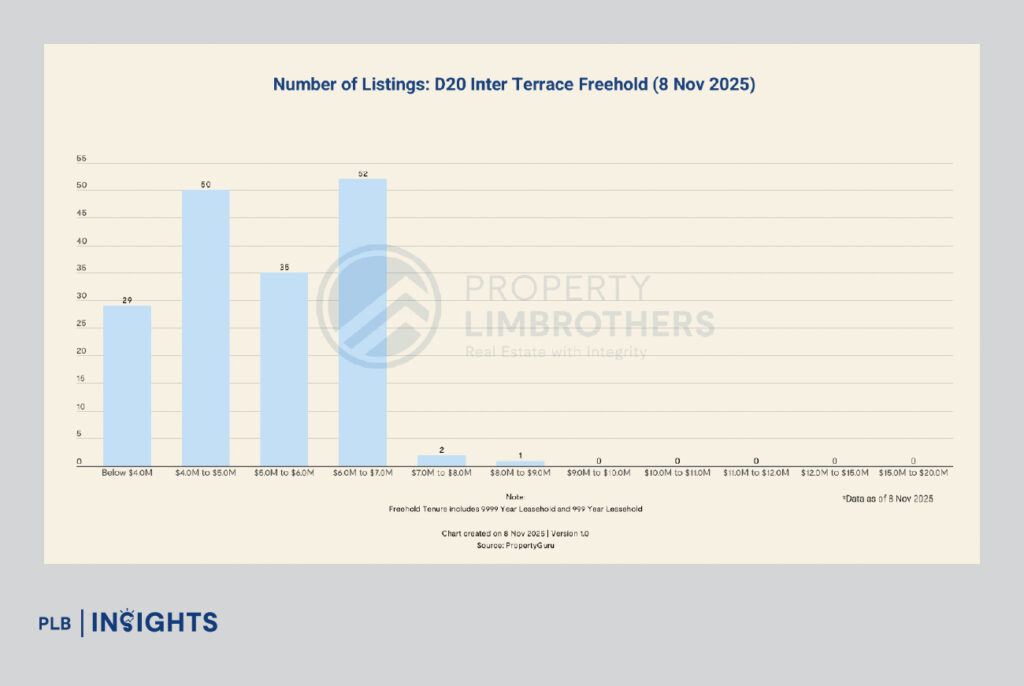
Inter-terrace homes form the backbone of D20’s landed liquidity and represent the most accessible entry point into landed ownership within the district.
Typical price range:
Most inter-terrace homes in D20 transact within the $4M to $7M band, with the strongest activity clustered between $4.5M and $6.5M. Entry-level prices below $4M have become increasingly rare.
Who they suit best:
Inter-terraces are best suited for young families, professional couples with children in mind, and first-time landed buyers upgrading from large condominiums or premium HDB flats. At this price range, buyers are usually balancing mortgage comfort, renovation budgets, and long-term affordability.
Why inter-terraces work in D20:
At these quantum levels, inter-terraces offer a rare combination of centrality, freehold tenure, and family-friendly surroundings. Liquidity remains strong because this price band is aligned with real-world budgets rather than aspirational reaches.
What buyers should consider carefully:
Buyers should scrutinise internal width, layout efficiency, and renovation scope. Spending an additional $500K on renovation in this tier must still make sense relative to neighbouring transactions. Over-improving an inter-terrace beyond its natural price ceiling can reduce flexibility when it comes time to sell.
Corner-Terrace Homes: More Space, Without a Major Quantum Leap
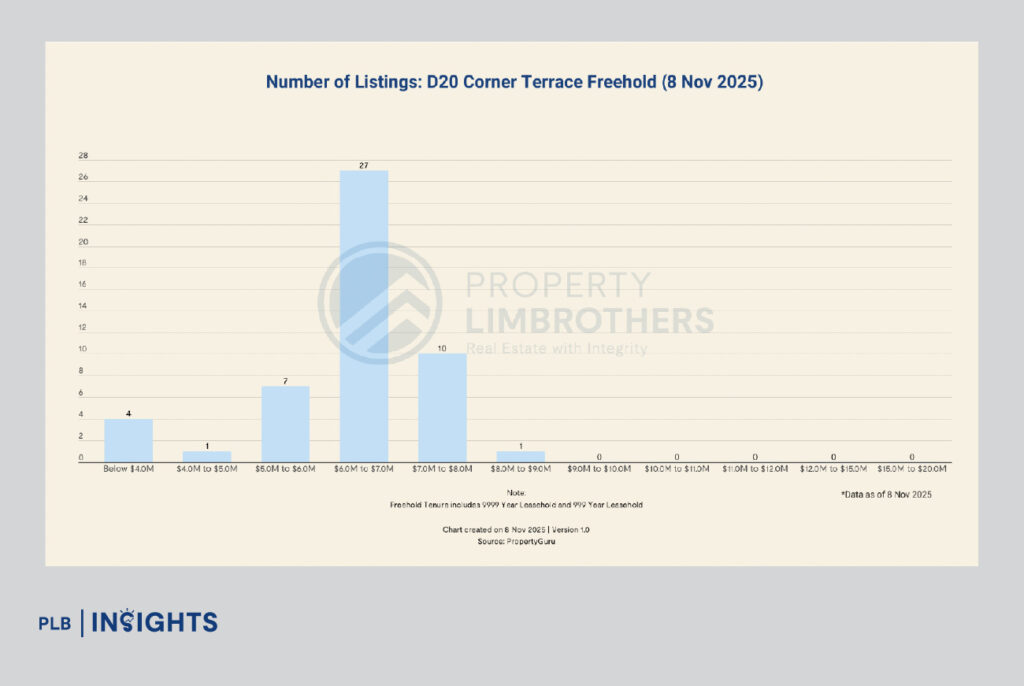
Corner-terrace homes sit comfortably above inter-terraces, offering greater land exposure and privacy without an immediate jump into semi-detached pricing.
Typical price range:
Corner terraces in D20 are commonly priced between $6M and $8M, with the bulk of demand concentrated in the $6M to $7.5M range. Supply is limited, which helps anchor pricing despite periodic increases in listings.
Who they suit best:
These homes work well for families who have outgrown inter-terraces — whether due to children, work-from-home needs, or multigenerational considerations — but are still price-conscious about stepping into the semi-detached category.
Why corner terraces stand out:
At this price range, buyers gain meaningful frontage and daylight advantages while remaining within a mid-tier landed quantum. The segment appeals strongly to owner-occupiers rather than speculative buyers, which keeps resale behaviour relatively disciplined.
What to watch out for:
Not every corner justifies its premium. Buyers should evaluate whether the land shape, road exposure, and building orientation genuinely improve liveability. Renovation and rebuilding ambitions often escalate quickly in this tier, so buyers should be cautious not to blur into semi-detached pricing without gaining corresponding benefits.
Semi-Detached Homes: The Long-Term Family Workhorse — With a Quantum Caveat
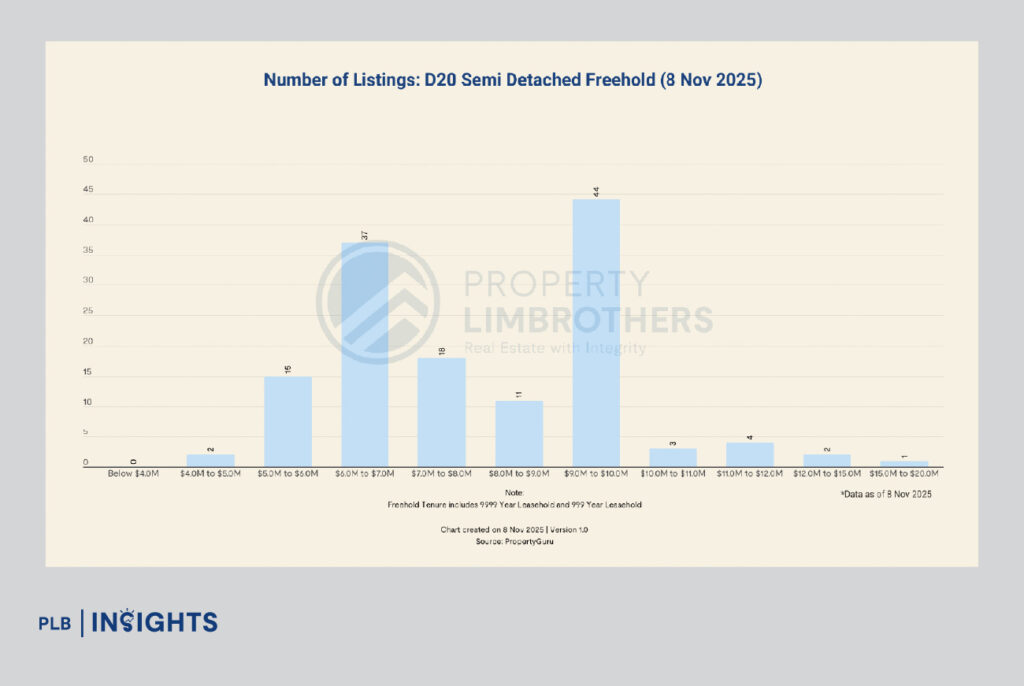
Semi-detached homes represent a major step up in commitment and are one of the most structurally important parts of D20’s landed market.
Typical price range:
Most semi-detached homes in D20 fall between about $5M and $10M, with the bulk of listings concentrated in the $6M–$7M, $7M–$8M, $8M–$9M and especially $9M–$10M bands. There is a small tail of older or more compact units around $4M–$5M, while at the upper end, a thinner layer of rebuilt or architect-designed semi-detached homes sits in the $10M–$15M range, with a handful of ultra-premium units above that.
Who they suit best:
Semi-detached homes are suited for families planning long-term stays, multi-generational households, or buyers who already understand the demands of landed living. These are homes typically held for decades rather than cycled through.
Why semis remain powerful in D20:
At these price levels, semis provide substantial living space, stronger privacy, and flexible layouts that accommodate evolving family needs. They benefit from D20’s school networks, MRT connectivity, and mature estate planning.
The critical pricing consideration buyers must not overlook:
This is where buyers must be especially disciplined about quantum. At the upper end of the semi-detached range, pricing can begin to overlap with entry-level detached homes, either within D20 or in nearby districts.
At that point, buyers may inadvertently forgo the opportunity to move into a higher landed tier — one with greater land ownership, privacy, and long-term defensibility. Semi-detached homes make the most sense when chosen for functional, lifestyle-driven reasons, not when priced close to detached alternatives.
Detached Homes: Legacy Assets at the Top of the Price Pyramid
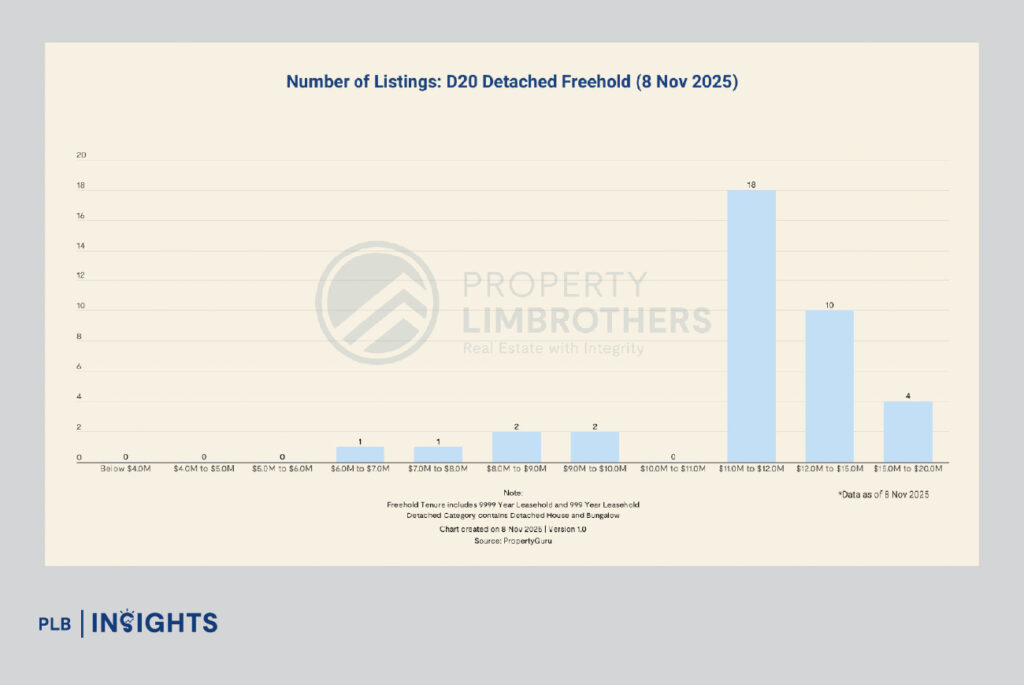
Detached homes sit at the top of D20’s landed hierarchy and behave fundamentally differently from other segments.
Typical price range:
Detached homes in D20 generally transact from $11M upwards, with many listings clustered between $11M and $15M, and select properties exceeding $15M depending on land size, location, and rebuilding potential.
Who they are suited for:
Detached homes are best suited for families with substantial holding power, multi-generational planning goals, and a long-term outlook. These buyers are typically not upgrading incrementally but making a decisive, long-duration commitment.
Why detached homes in D20 are unique:
Transactions are infrequent, and owners rarely sell unless there is a significant life change. Value here is anchored by land scarcity, micro-location, and long-term replacement difficulty — not short-term market cycles.
What buyers may underestimate:
Detached homes come with higher ongoing costs and longer planning horizons. Renovation or rebuilding decisions must be thought through carefully, and resale liquidity is naturally lower. These homes reward patience and conviction, not impulse.
Common Buyer Mistakes Across Landed Price Tiers
Across all landed types, several missteps repeat:
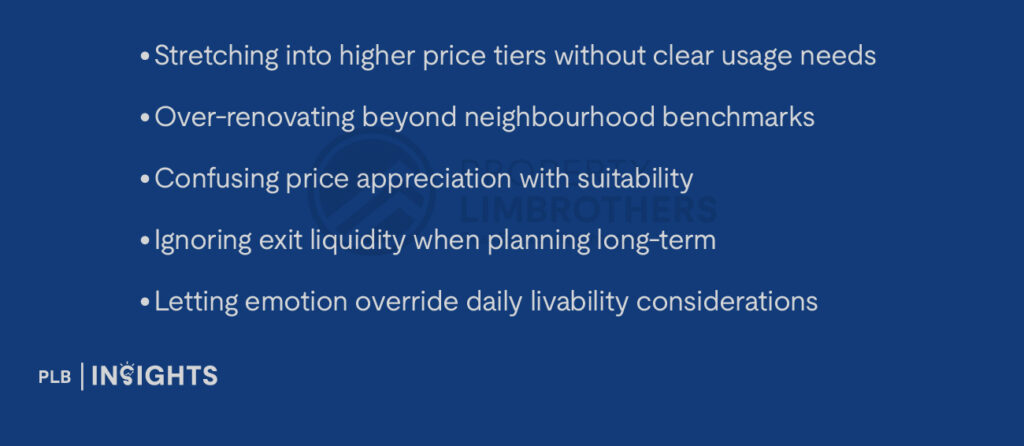
In landed homes, pricing errors compound over time.
Choosing the Right Landed Type for Your Life Stage and Budget
The most successful landed buyers in D20 align four factors carefully:
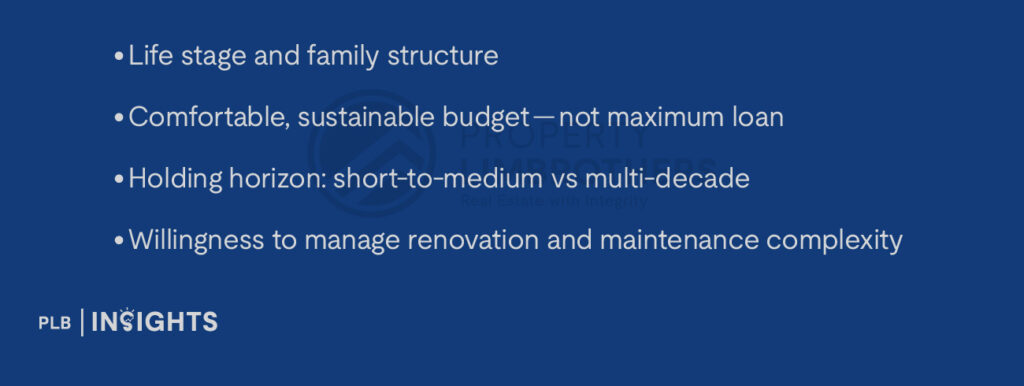
When these align with the correct price tier, outcomes tend to be stable even across different market cycles.
Closing Thought: The Right Landed Home Is the One That Fits — Financially and Functionally
District 20 offers no objectively “best” landed home — only choices that fit different life stages and price comfort zones. Inter-terraces provide accessibility and liquidity, corner terraces add usable space without excess, semi-detached homes anchor long-term family living, and detached homes serve as legacy assets.
In a district defined by structural stability rather than hype, the best landed decision is rarely the most expensive one. It is the one that fits both your lifestyle and your price discipline — not just today, but many years down the road.
If you are considering a home in District 20, informed positioning and micro-location insight are essential. Our sales consultants can help you navigate this rare segment with clarity and confidence. Click here to get in touch.
Thank you for reading, and stay tuned! For more detailed insights regarding the landed property market, join our Landed VIP Club and stay updated with the latest market trends and expert advice.